
A National Care Service: The Missing Half of the NHS?

Andy Burnham has promised to create a National Care Service. The name is ambitious, but the detail remains sparse. Would it be an NHS for social care, a new funding system or simply a national framework for services that continue to be delivered locally?
Although the final design will depend on Baroness Louise Casey’s review, now due in summer 2027, the clues in the public domain allow us to make some informed predictions.
What has Burnham actually promised?
Burnham has set four principles for the new service:
people should move seamlessly between hospitals, home care and community services;
care must be fully and sustainably funded;
the system should prioritise prevention and independent living;
citizens’ needs should come before the organisational and financial boundaries separating the NHS, councils and other services.
These principles point towards something more significant than another change to care fees. They suggest an attempt to complete the unfinished business of the NHS by bringing health and social care into a more coherent system.
National rights, locally delivered
“National” does not necessarily mean nationalisation.
England’s care services are currently delivered by a mixture of councils, charities and private providers. Replacing that entire system with one centrally managed organisation would be disruptive, expensive and inconsistent with Burnham’s longstanding support for devolution.
A more likely model would establish national entitlements, eligibility rules and quality standards, while services continue to be organised locally.
The government would guarantee what people are entitled to receive. Local or regional bodies would decide how best to deliver it.
This could reduce the current postcode lottery, under which access to support can depend heavily on where someone lives, the finances of their council and their ability to navigate a complicated assessment process.
One person, one care journey
The clearest clue is Burnham’s determination to remove the divide between the NHS and social care.
That divide makes little sense to patients and families. Someone can move from free NHS treatment to means-tested social care even though their underlying condition has not changed. Hospitals, councils, community teams and care providers may all be supporting the same person, but through different assessments, budgets and systems.
A National Care Service could provide:
a single assessment of health and care needs;
one care plan shared between organisations;
a named person coordinating support;
pooled NHS and social-care budgets;
shared records and commissioning arrangements.
From the citizen’s perspective, the aim would be simple: one care journey rather than a succession of organisational handovers.
Prevention before crisis
Burnham has also emphasised helping people remain independent for longer.
Today’s system frequently intervenes only after a crisis. Yet relatively modest support—home adaptations, rehabilitation, respite care or regular help at home—can prevent a fall, a hospital admission or an early move into residential care.
The National Care Service is therefore likely to place greater emphasis on community and home-based support. This would not only improve people’s lives; it could also relieve pressure on hospitals by preventing avoidable admissions and enabling patients to be discharged sooner.
In that sense, social-care reform is also NHS reform.
A new deal for care workers
Any credible National Care Service must address the care workforce.
Low pay, insecure employment and limited career progression contribute to persistent vacancies and high staff turnover. Burnham has repeatedly argued that care workers deserve better recognition, pay and conditions.
The new service could introduce national employment and training standards, recognised qualifications and clearer career paths. Workers might continue to be employed by different providers, but organisations receiving public funding could be required to meet these standards.
Without that workforce settlement, a National Care Service would risk becoming little more than a new name attached to the same fragile system.
Will social care become free?
This is the biggest unanswered question.
The title invites comparisons with the NHS, but making every aspect of social care free—including accommodation and round-the-clock residential support—would be extremely expensive.
A more likely first step would be a universal entitlement to essential personal care, such as help with washing, dressing and eating. Accommodation and ordinary living costs might remain chargeable, at least initially.
Burnham has said that reform must be sustainably funded and has not ruled out difficult tax decisions. His previous support for a levy on estates suggests that he favours pooling the financial risk across society, rather than allowing a relatively small number of families to face catastrophic care costs.
The funding mechanism remains uncertain. What is increasingly clear is that a National Care Service cannot be built on occasional grants and permanently overstretched council budgets.
What might emerge?
The public clues suggest a service built around:
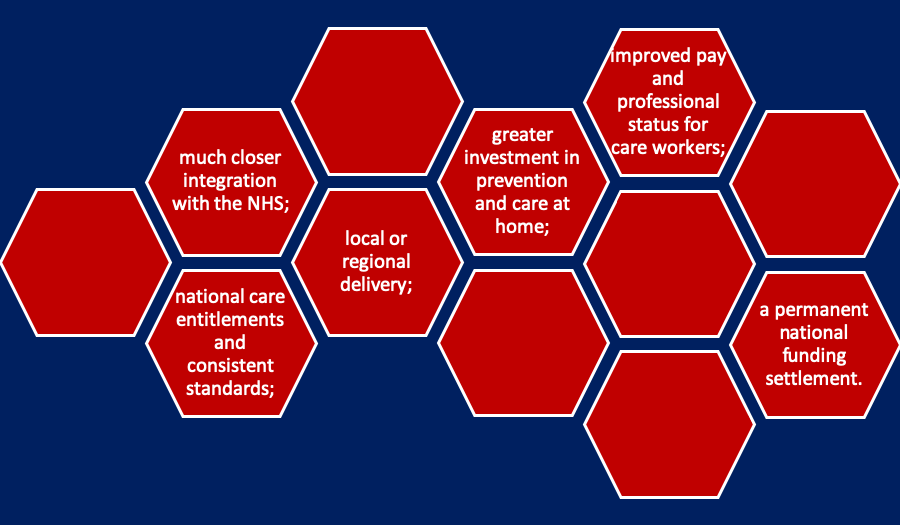
That would not necessarily create a state-run monopoly. Independent, charitable and public-sector organisations could all continue providing services—but within a system offering clearer rights and stronger public accountability.
The political challenge is no longer simply to describe the failures of social care. It is to define what every citizen should be entitled to receive and explain honestly how the country will pay for it.
The NHS transformed access to health care. Burnham’s ambition appears to be to build its missing half: a care service that is equally clear, dependable and fair.
Whether that ambition survives contact with the funding question will determine whether the National Care Service becomes a historic reform—or merely the latest promise in social care’s long history of false starts.
Comments